

SLM-DCO-15P#
Description#
15-channel 24VDC sourcing discrete outputs.
Designed for industrial control applications requiring multiple DC outputs.
Outputs use sourcing (PNP) transistor switching.
Configuration#
No configuration required
Typical Modbus Register Mapping#
Channel |
Modbus Register |
Access |
|---|---|---|
CH1 |
00001 |
Read/Write |
CH2 |
00002 |
Read/Write |
CH3 |
00003 |
Read/Write |
CH4 |
00004 |
Read/Write |
CH5 |
00005 |
Read/Write |
CH6 |
00006 |
Read/Write |
CH7 |
00007 |
Read/Write |
CH8 |
00008 |
Read/Write |
CH9 |
00009 |
Read/Write |
CH10 |
00010 |
Read/Write |
CH11 |
00011 |
Read/Write |
CH12 |
00012 |
Read/Write |
CH13 |
00013 |
Read/Write |
CH14 |
00014 |
Read/Write |
CH15 |
00015 |
Read/Write |
Notes:
Outputs (CH1-CH15) are read/write and correspond to Modbus Coil Registers (00001 - 00015).
What should be Output (CH16) is reserved, but not used in this 15 channel module.
Specifications#
Example Usage#
Note
The following examples assume that it is the only module connected. Actual mapping may vary depending on the configuration of the system.
Getting Example Readings#
import time
from pyModbusTCP.client import ModbusClient
import struct

client_ip = '192.168.1.255'  # Replace with your device's IP
client = ModbusClient(host=client_ip, port=502, auto_open=True)

while True:
    client.write_single_coil(3, True); # Write 1 to coil address 3 (channel 4)
    time.sleep(1)
    client.write_multiple_coils(0, [True, False, True, False, True, False, True, False, True, False, True, False, True, False, True]); # Alternate values to coils 0-14
    time.sleep(1)
Note
This is an explanatory section on how to read/write to a module. For a more complete example using Python, visit Python Example.
#include <ArduinoModbus.h> // Include Modbus library

// Assume ModbusRTUClient is already initialized (e.g., ModbusRTUClient.begin(...))
int slaveId = 0x01;       // The ID of the Modbus slave device
int startAddress = 0;     // The starting address of the coils
int numCoils = 15;         // The number of coils to write (0-14)
int coilValues[] = {1, 0, 1, 0, 1, 0, 1, 0, 1, 0, 1, 0, 1, 0, 1}; // Values for coils 0 through 14

void setup() {
    # Setup modbus client
}

void loop() {
    writeMultipleCoilsPattern_BeginWriteEnd();
    delay(1000);
}

void writeMultipleCoilsPattern_BeginWriteEnd() {
  // Start writing multiple coils
  ModbusRTUClient.beginTransmission(slaveId, COILS, startAddress, numCoils);

  // Write the pattern 1, 0, 1, 0, 1, 0, 1, 0 for coils 0-7
  for (int i = 0; i < numCoils; i++) {
    // Write 1 for even coils (0, 2, 4, 6), 0 for odd coils (1, 3, 5, 7)
    ModbusRTUClient.write(coilValues[i]);
  }

  // Send the write request
  ModbusRTUClient.endTransmission();
}
Note
The above code uses the ArduinoModbus library and is not a complete program.
Note
This is an explanatory section on how to read/write to a module. For a more complete example using Arduino, visit Arduino Example.
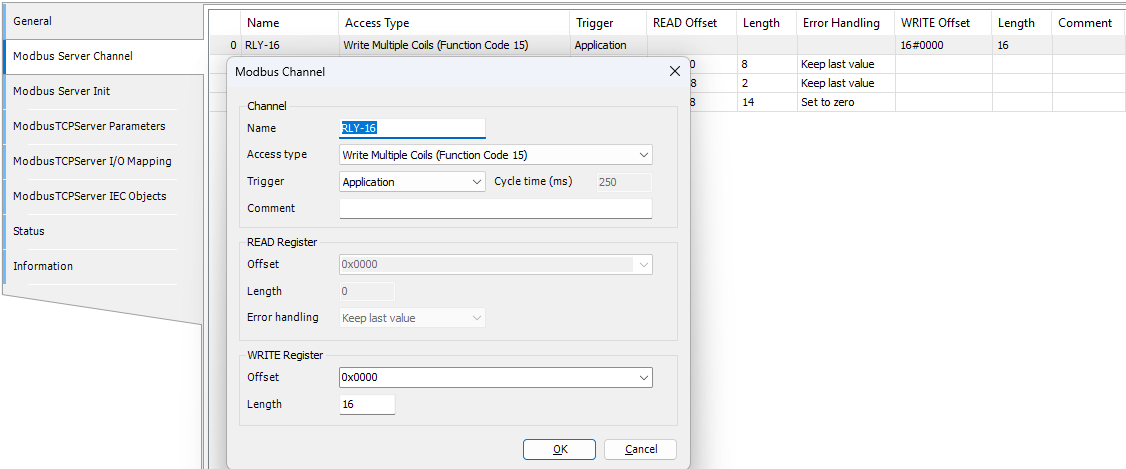
Under Modbus_TCP_Server -> Modbus Server Channel
 Under Modbus_TCP_Server -> Modbus Server Channel -> I/O Mapping
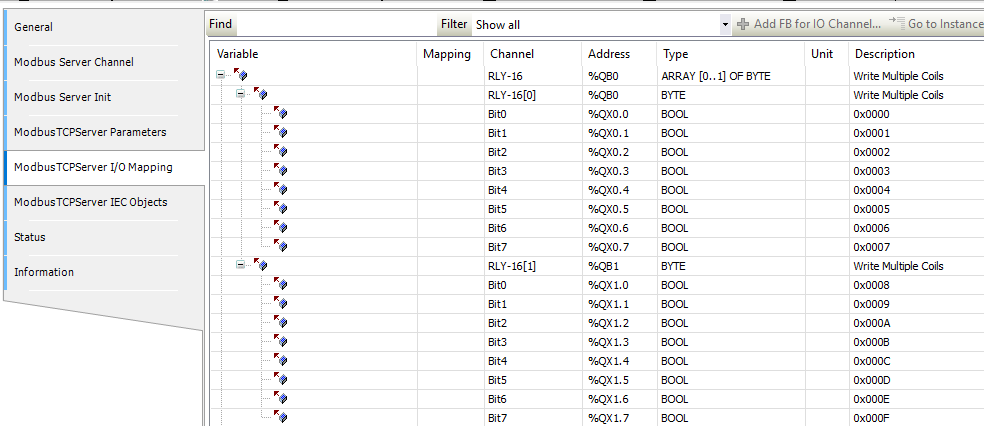 Usage
Usage
VAR
    DCO15_1 AT %QB0 : BYTE;
    DCO15_2 AT %QB1 : BYTE;
    DCOCH1 AT QX0.0 : BOOL;
    DCOCH2 AT QX0.1 : BOOL;
    DCOCH3 AT QX0.2 : BOOL;
    DCOCH4 AT QX0.3 : BOOL;
    DCOCH5 AT QX0.4 : BOOL;
    DCOCH6 AT QX0.5 : BOOL;
    DCOCH7 AT QX0.6 : BOOL;
    DCOCH8 AT QX0.7 : BOOL;
    DCOCH9 AT QX1.0 : BOOL;
    DCOCH10 AT QX1.1 : BOOL;
    DCOCH11 AT QX1.2 : BOOL;
    DCOCH12 AT QX1.3 : BOOL;
    DCOCH13 AT QX1.4 : BOOL;
    DCOCH14 AT QX1.5 : BOOL;
END_VAR
Note
This is an explanatory section on how to read/write to a module. For a more complete example using Codesys, visit Codesys Example.
Tag
Tag Name |
Type |
|---|---|
DO1 |
Boolean |
DO2 |
Boolean |
DO3 |
Boolean |
DO4 |
Boolean |
DO5 |
Boolean |
DO6 |
Boolean |
DO7 |
Boolean |
DO8 |
Boolean |
DO9 |
Boolean |
DO10 |
Boolean |
DO11 |
Boolean |
DO12 |
Boolean |
DO13 |
Boolean |
DO14 |
Boolean |
DO15 |
Boolean |
Usage
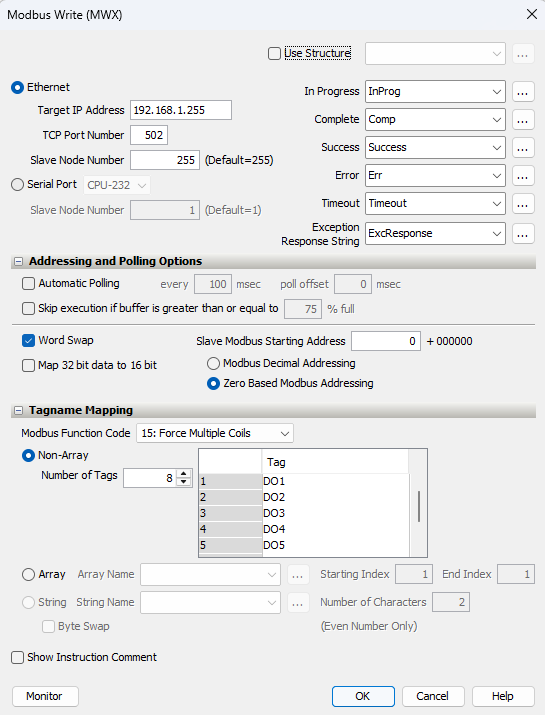
Note
This is an explanatory section on how to read/write to a module. For a more complete example using Productivity Suite, visit Productivity Suite Example.
Safety Precautions#
Do not add or remove modules while field power is applied.
Ensure proper grounding and wire connections to prevent electrical hazards.
Follow all local and national electrical codes.
Maintain adequate ventilation to prevent overheating.
For more details and technical support, visit Synergy Logic or contact support@synergy-logic.com.